
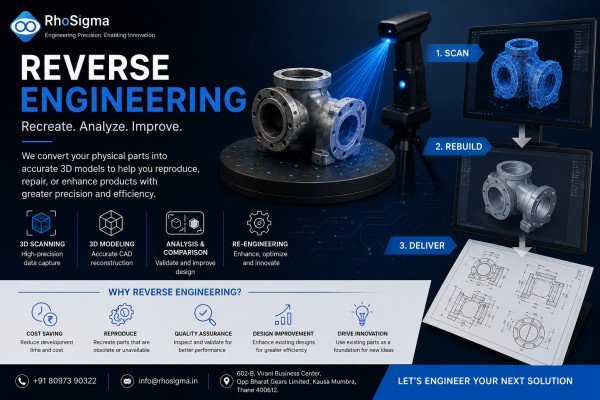
Why Reverse Engineering Solutions Are Essential for Modern Manufacturing
Michel
July 3, 2026

Product manufacturers are always looking for the competitive advantage-the need for ever more innovative designs, better products, and faster production, while always trying to keep costs in check, are part of that equation. The need for better-qualified engineers with more creative design solutions is ever more pressing. Whether your need is to improve an existing product’s design, to understand a competitor’s technology, or even to replace old equipment, reverse engineering can be a powerful and cost-effective solution.
Reverse engineering begins with a detailed analysis and understanding of a product, including its physical geometry, materials and methods used, and how it operates and functions.
All of this data is captured in order to create digital engineering assets (such as CAD data, 2D drawings and manufacturing data) which can be then be used as part of the company’s product development process. The data can be used as documentation to maintain obsolete products, replace old machinery or simply used as design reference for new products. When manufacturers cannot rely on their old documents, and know that an equipment design can be modified or even used in the design of a totally new product, reverse engineering makes it easy to find what is missing. By providing manufacturers with the ability to examine, scan and analyze competitor product designs, reverse engineering can quickly reveal their competitive technology with impressive speed.
This type of design analysis helps manufacturers understand their own products in comparison, what makes competitors more competitive and what makes better products.
Today’s advanced reverse engineering tools incorporate sophisticated technologies like precision 3D scanning, 3D modeling and a vast array of material characterization instruments that can deliver the most accurate results. Product data that was lost or that simply was not created will be found using these highly advanced solutions. Over time the product’s documentation gets lost or becomes irrelevant as updates are made but documentation does not follow so eventually the manufacturer loses touch with original design information, so creating these accurate design data becomes essential to maintain a product and service it.
When a product is no longer supplied by the original vendor because of closure or discontinuation of products, reverse engineering offers an inexpensive means to rebuild old machinery. Manufacturers need to find alternatives to avoid shutdown, increase operational efficiencies and productivity. For companies in the aerospace, automotive, electronics and industrial automation sectors the demand for efficient and affordable technology solutions is constant, they make heavy use of the capability to analyze their designs and improve or re-engineer them.
Analyze mechanical systems, assembly and electronic designs help these industries provide better-designed and cost-effective products.
By analyzing an existing product with a high degree of accuracy, design engineers can identify numerous ways to improve performance, reduce manufacturing costs and increase product reliability. Reverse engineering can significantly streamline the design process while at the same time yielding product enhancements that result in greater overall value. For digital manufacturing organizations reverse engineering plays a crucial role. Being able to create high quality digital design data makes the entire lifecycle of product design much easier and more complete, providing better design analysis and even helping with the prototyping process.
We understand how valuable product design knowledge is to companies today and we also appreciate the many challenges that manufacturers are facing.
Rhosigma offer end-to-end reverse engineering solutions to meet all your design data needs including analysis, digital design creation and optimization of your existing product designs, with highly advanced techniques combined with sound engineering experience.

The resource requested could not be found on this server!
Please be advised that LiteSpeed Technologies Inc. is not a web hosting company and, as such, has no control over content found on this site.