
Dreams are a part of Shariah. For the Ummah, dreams are regarded as glad tidings (Mubashshirat), while the dreams of the Prophets عليهم السلام were a form of revelation (Wahy).
The revelation to the Prophet ﷺ began with true dreams. This shows that dreams have a place in Shariah.
Distinguishing between true and false dreams is the responsibility of those who are experts in this field. Many people reject dreams without giving them proper thought, and this is a form of misguidance.
The Ash’ari scholars included dreams among the matters of belief.
Some people think that the Naqshbandi and Shadhili spiritual paths are based only on dreams. This is incorrect. We follow the religion, and dreams are a part of the religion. It was also the practice of the Prophet ﷺ to ask about dreams after the Fajr prayer and explain their interpretation.
As mentioned in the Hadith:
عَنْ سَمُرَةَ بْنِ جُنْدُبٍ قَالَ: كَانَ النَّبِيُّ صَلَّى اللَّهُ عَلَيْهِ وَسَلَّمَ إِذَا صَلَّى الصُّبْحَ أَقْبَلَ عَلَيْهِمْ بِوَجْهِهِ فَقَالَ: هَلْ رَأَى أَحَدٌ مِنْكُمْ اللَّيْلَةَ رُؤْيَا؟
(Sahih al-Bukhari: Hadith 7017, Sahih Muslim: Hadith 2264)
Translation:
Narrated by Hazrat Samurah bin Jundub رضي الله عنه: Whenever the Prophet ﷺ finished the Fajr prayer, He would turn towards the Companions and ask:
“Did anyone among you see a dream last night?”
The dreams of truthful people are truthful. The Companions رضي الله عنهم were truthful, so their dreams were also true. They also understood the interpretation of dreams.
Today, even many scholars are unfamiliar with the knowledge of dream interpretation, although the inheritors of the Prophets should possess knowledge of interpreting dreams.
Guidance on the Art of Dream Interpretation:
It is not appropriate to interpret dreams based on assumptions by simply referring to books.
Anyone who wishes to learn the art of dream interpretation should practice the following. By its blessing, he may gradually gain some skill in interpreting dreams.
The practice is to recite the Kalimah Tayyibah 17,000 times and Surah Al-Ikhlas three times, then dedicate the reward (Isal al-Thawab) to Ibn Sirin رحمه الله. After that, begin studying Allama Ibn Sirin’s book “Ta’bir al-Ru’ya”. In this way, one will gradually develop expertise in the art of dream interpretation.
For perfection in this field, it is also necessary to perform spiritual exercises (Chillah and Riyazat) under the supervision of a perfect spiritual guide who strictly follows the Sunnah.
Through the blessings of this practice, a person will gain enough knowledge to understand dreams.
The art of dream interpretation is extremely delicate and precise. Many frightening and terrifying dreams actually have very good interpretations.
The Dream of Harun al-Rashid’s Wife:
Once, Zubaydah, the wife of Caliph Harun al-Rashid, saw a dream that appeared to be unpleasant. Zubaydah was a very devout, pious, righteous woman and a friend of Allah.
She saw herself standing at a crossroads, and every man who came toward her committed adultery with her and then left. For such a devout and pious woman, seeing a dream like this was extremely distressing.
As soon as she saw the dream, she became deeply worried and instructed her maidservant, “Without mentioning my name, relate this dream as if it were your own and ask the famous dream interpreter Allama Ibn Sirin رحمه الله for its interpretation.”
Zubaydah did not allow her name to be mentioned because she did not know what the interpretation of such a dream might be and feared that it could become a cause of disgrace.
Following her instructions, the maidservant went to Allama Ibn Sirin رحمه الله and said:
“Sir, I have seen such a dream. What is its interpretation?”
After hearing the dream, Allama Ibn Sirin رحمه الله immediately replied:
“This cannot be your dream. Such a dream cannot be seen by just anyone. It is the dream of a fortunate person. First tell me truthfully whose dream it is, then I will explain its interpretation.”
The maidservant replied:
“Sir, the person who saw this dream has forbidden me from revealing her name.”
Allama Ibn Sirin رحمه الله said:
“First obtain her permission. Otherwise, I will not interpret the dream.”
The maidservant returned to Zubaydah and conveyed everything, saying:
“Ibn Sirin says that you must first tell him whose dream it is, then he will explain its interpretation.”
Zubaydah then said to the maidservant:
“Very well, go and tell him that Zubaydah saw this dream.”
The maidservant returned to Allama Ibn Sirin رحمه الله and informed him that the dream belonged to Zubaydah.
He said:
“I had already told you that this was not an ordinary dream. It could only belong to someone fortunate.”
He then gave its interpretation, saying:
“Allah Almighty will enable the Queen to establish such a Sadaqah Jariyah (continuous charity) through her hands that people will continue to benefit from it until the end of time.”
When the maidservant returned and informed Zubaydah of the interpretation, she immediately thanked Allah. Although the dream appeared very strange, its interpretation turned out to be very good.
A few years later, when Harun al-Rashid intended to perform Hajj, Queen Zubaydah accompanied him.
About twelve to thirteen hundred years ago, during the reign of Harun al-Rashid, Makkah Mukarramah suffered from a severe shortage of water, and the pilgrims faced great difficulty in obtaining it.
When Harun al-Rashid and Queen Zubaydah arrived in Makkah Mukarramah, the local people, knowing the Queen’s kind and compassionate nature, approached her instead of Harun al-Rashid and said:
“There is a great shortage of water in Makkah Mukarramah. If you think it appropriate, please arrange a way for water to become easily available here.”
Queen Zubaydah understood that this was a very important place where people from many other countries also came. Since they were facing a shortage of water, she realized that this hardship had to be removed by any possible means.
Zubaydah first sought permission from Harun al-Rashid, and it was granted without delay.
At that time, Islam was at the height of its strength. The disbelieving powers were under the authority of the Muslims, the Muslims were dominant throughout the world, and their influence was widely recognized.
Experts in every field were present among the Muslims during that period.
Queen Zubaydah announced throughout the entire kingdom that all skilled engineers, wherever they were, should come to Makkah Mukarramah.
As soon as the announcement was made, expert engineers from all the major cities gathered, and a large group of specialists arrived.
Queen Zubaydah called them together and said:
“I want water to reach every corner and every street of Makkah Mukarramah. How it will come and where it will come from is your responsibility.”
All the engineers sat together, discussed the matter, and prepared a plan.
They laid a network of Nahr Zubaydah around Makkah Mukarramah. Every spring flowing from the surrounding mountains and every stream of water was connected to the canal.
The canal was approximately fourteen miles long. It was constructed in such a way that reservoirs were built at various locations, so that if someone was outside the city, they could simply lift the cover and obtain water from those reservoirs.
When Nahr Zubaydah was completed, the engineer who was responsible for the entire project prepared the financial records and traveled to Baghdad. He then arrived at the palace of Queen Zubaydah.
At that time, Queen Zubaydah was relaxing on the bank of the River Tigris (Dajlah).
She was informed:
“The engineer has arrived from Makkah Mukarramah with the accounts of Nahr Zubaydah.”
Zubaydah immediately summoned the engineer.
He presented the file and said:
“Your Majesty, this is the financial record for the completion of the Nahr Zubaydah project. I have fulfilled the task that you assigned to me. A plentiful supply of water has now been arranged in every street and every neighborhood of Makkah Mukarramah. By the will of Allah, neither the residents of Makkah Mukarramah nor those coming for Hajj and Umrah will face any shortage of water. Here are the accounts before you. Please review them and grant me permission to leave.”
Zubaydah took the file, signed it, tore it into two pieces, and threw it into the River Tigris.
She then said the famous words that have been preserved in history to this day:
“We have left its account for the account of the Hereafter.”
She further said:
“If anything is due from us, take it. And if anything is due to us from you, we have forgiven it.”
The canal constructed by Queen Zubaydah bint Ja’far, the wife of the Abbasid Caliph Harun al-Rashid, originated from the River Tigris (Dajlah) in Iraq. It passed near the present-day Saudi Arabian city of Rafha and extended to Makkah Mukarramah and the Plain of Arafat. Its remains can still be seen today.
Similarly, some people see dreams in which they are having intercourse with their own daughters or with their Shaykh (spiritual guide). Although such dreams appear unpleasant, their interpretation is good, indicating that the dreamer will receive benefit or gain.
Applying One’s Dream to Someone Else:
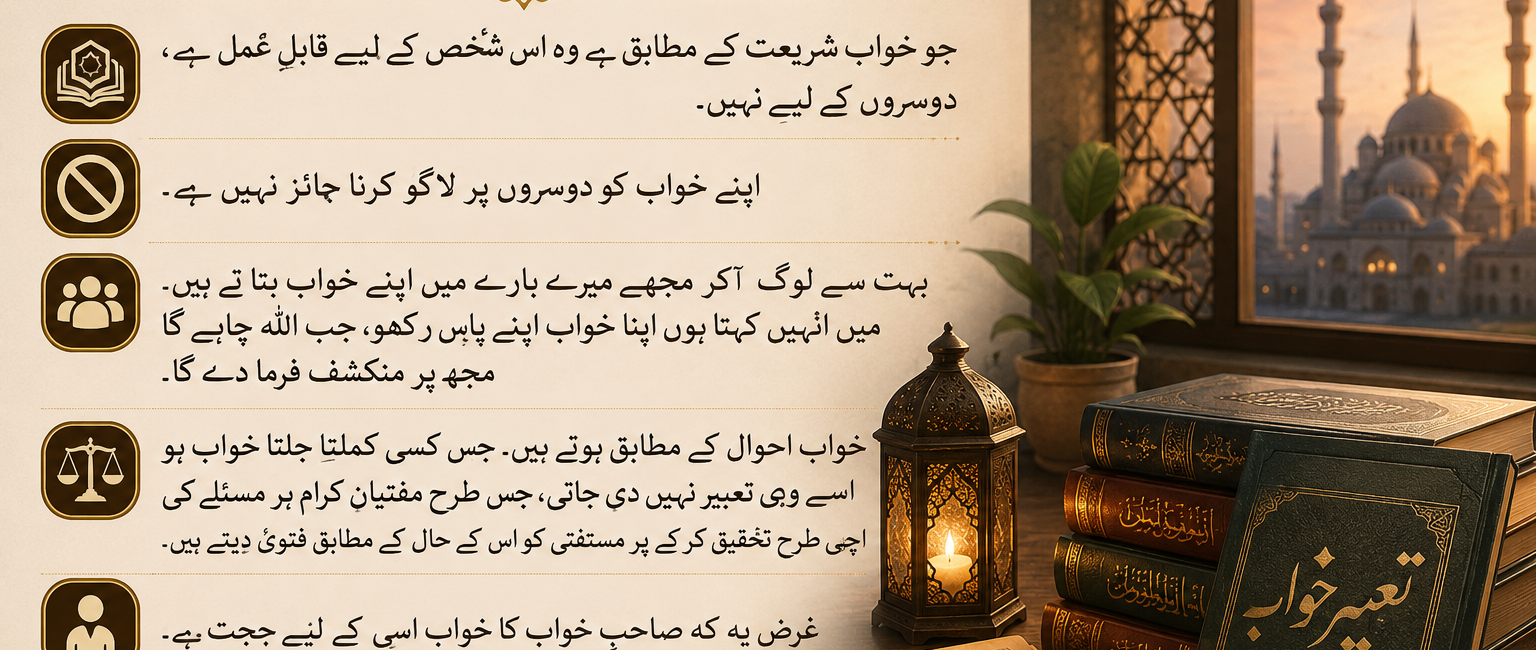
A dream that is in accordance with the Shariah is applicable only to the person who saw it and not to others. It is not permissible to apply one’s dream to someone else.
Many people come to me and tell me the dreams they have seen about me. I tell them, “Keep your dream to yourself. When Allah wills, He will reveal it to me Himself.”
Dreams vary according to a person’s circumstances and condition. Even if two people see similar dreams, they are not necessarily given the same interpretation.
Just as the respected Muftis carefully investigate every issue before issuing a fatwa according to the questioner’s particular circumstances, dream interpretation is also based on the condition of the person who saw the dream.
In short, a person’s dream is evidence only for the one who has seen it.
Rejecting dreams without proper thought and understanding is a form of misguidance.