
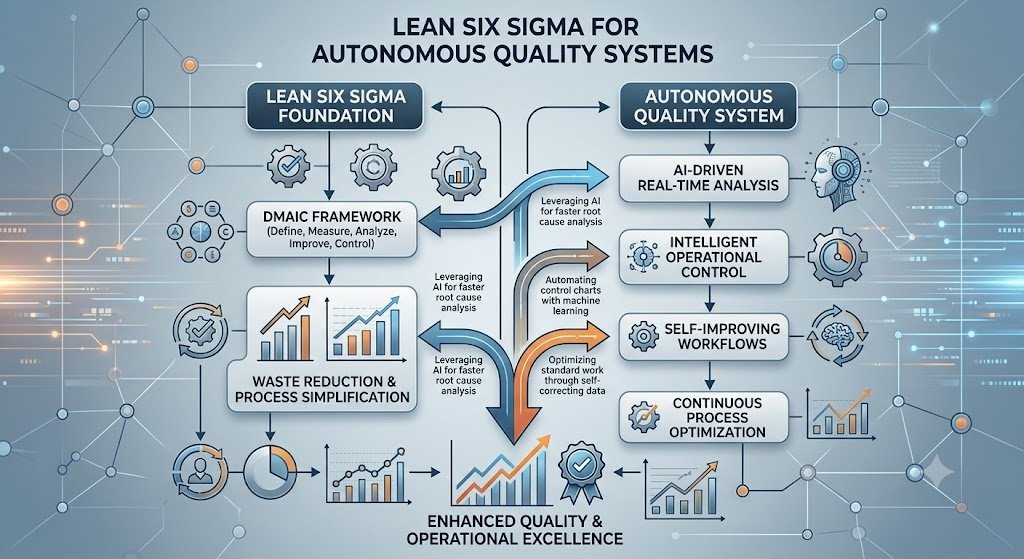
Lean Six Sigma for Autonomous Quality Systems: Building Self-Improving Workflows
Introduction
Why Autonomous Quality Systems Are Becoming a Strategic Priority
Organizations are under increasing pressure to improve quality while simultaneously reducing costs, minimizing defects, and accelerating operational performance. Traditional quality management approaches often struggle to keep pace with modern production environments that generate vast amounts of real-time data.
As businesses continue adopting artificial intelligence, advanced analytics, and connected operational technologies, autonomous quality systems are emerging as a strategic solution. These systems continuously monitor performance, identify risks, recommend improvements, and optimize processes with minimal human intervention.
The Challenge of Continuous Quality Improvement at Scale
Continuous improvement becomes significantly more complex as organizations expand across facilities, regions, and business units. Maintaining process consistency while adapting to changing operational conditions requires a level of responsiveness that manual quality systems often cannot achieve.
This challenge has led many organizations to explore lean six sigma for autonomous quality systems as a framework for building intelligent, self-improving workflows.
Direct Answer: How Lean Six Sigma Enables Self-Optimizing Operations
Lean Six Sigma provides the structured methodology required to create autonomous quality systems. By reducing variation, eliminating waste, standardizing processes, and embedding data-driven decision-making into operational workflows, organizations establish the foundation necessary for autonomous optimization.
When combined with AI-driven quality management and intelligent operational control, Lean Six Sigma enables systems to detect issues, identify root causes, implement corrective actions, and continuously improve performance without constant human intervention.
Understanding Autonomous Quality Systems
Defining Autonomous Quality Management
Autonomous quality management refers to systems that independently monitor, analyze, and improve operational quality through advanced analytics, machine learning, and automated decision-making.
Unlike traditional quality programs that rely heavily on manual reviews, autonomous systems continuously evaluate process performance and initiate improvements in real time.
Core Components of Self-Improving Workflows
Self-improving workflows typically include:
- Real-time data collection
- Automated quality monitoring
- Predictive analytics
- Root cause analysis engines
- Intelligent decision support
- Continuous feedback loops
These components work together to support ongoing optimization.
The Evolution From Automated Processes to Autonomous Systems
Automation executes predefined actions based on programmed rules. Autonomous systems go further by learning from operational data, adapting to changing conditions, and improving decision-making over time.
This evolution represents a significant advancement in quality management capabilities.
Lean Six Sigma as the Foundation of Autonomous Quality
Reducing Process Variation Before Automation
One of the most important principles of lean six sigma for autonomous quality systems is the reduction of process variation before introducing automation.
Automating unstable processes often magnifies existing quality problems. Lean Six Sigma helps organizations establish stable, predictable workflows before autonomous technologies are deployed.
Embedding DMAIC Logic Into Autonomous Decision Loops
The DMAIC framework—Define, Measure, Analyze, Improve, and Control—remains highly relevant in autonomous environments.
AI systems can incorporate DMAIC principles by:
- Defining performance objectives
- Measuring process behavior
- Analyzing deviations
- Implementing improvements
- Monitoring ongoing results
This creates a structured foundation for autonomous decision-making.
Creating Stable Conditions for Continuous Optimization
Process stability allows autonomous systems to accurately detect meaningful deviations and improvement opportunities without being overwhelmed by excessive variation.
Designing Self-Improving Workflows
Building Closed-Loop Feedback Mechanisms
Closed-loop feedback systems continuously collect performance data and use that information to guide corrective actions.
This enables quality systems to learn from operational outcomes and improve future decisions.
Converting Process Data Into Autonomous Actions
Modern operations generate large volumes of process data. Autonomous systems transform this information into actionable insights that drive continuous improvement.
Eliminating Recurring Sources of Operational Waste
Lean methodologies identify and remove inefficiencies that contribute to defects, delays, rework, and excess costs.
Creating Adaptive Improvement Cycles
Adaptive workflows continuously evaluate performance and adjust processes based on changing operational conditions.
Table: Workflow Stage vs Autonomous Quality Function
| Workflow Stage | Autonomous Quality Function |
| Data Collection | Real-time monitoring |
| Analysis | Pattern recognition |
| Root Cause Investigation | AI-driven diagnostics |
| Improvement | Automated recommendations |
| Control | Continuous performance monitoring |
AI-Driven Quality Management Architecture
Real-Time Data Collection and Quality Monitoring
Advanced sensors, IoT devices, and connected production systems provide continuous visibility into quality performance.
Predictive Defect Detection Systems
Machine learning models can identify patterns that indicate future quality issues before defects occur.
This supports proactive intervention rather than reactive correction.
Automated Root Cause Identification
AI-driven systems analyze process relationships to determine the most likely causes of quality failures.
Intelligent Corrective Action Recommendations
Autonomous quality systems can generate corrective action recommendations based on historical outcomes and operational best practices.
Continuous Learning Through Operational Feedback
One of the greatest advantages of lean six sigma for autonomous quality systems is the ability to continuously improve decision quality through learning mechanisms.
Intelligent Operational Control Systems
Dynamic Process Adjustment Based on Live Conditions
Operational conditions constantly change due to environmental factors, equipment performance, and production requirements.
Autonomous systems can adjust process parameters in real time to maintain quality standards.
Autonomous Control of Critical Quality Variables
Critical process variables such as temperature, pressure, speed, and material flow can be automatically managed to prevent defects.
Real-Time Process Stability Management
Maintaining process stability is essential for predictable quality performance.
Coordinating Quality Across Connected Operations
Enterprise-wide visibility allows organizations to manage quality consistently across multiple facilities and business functions.
Comparison Table: Traditional Quality Management vs Autonomous Quality Systems
| Traditional Quality Management | Autonomous Quality Systems |
| Periodic inspections | Continuous monitoring |
| Manual analysis | AI-driven analytics |
| Reactive responses | Predictive intervention |
| Human-driven decisions | Intelligent recommendations |
| Limited scalability | Enterprise-wide scalability |
Preventing Quality Drift in Autonomous Environments
Maintaining Process Capability Over Time
Process capability remains a critical metric for evaluating long-term quality performance.
Autonomous systems must continuously monitor capability indicators and initiate corrective actions when necessary.
Monitoring Algorithm Performance
Machine learning models require ongoing validation to ensure accurate predictions and recommendations.
Managing Exceptions and Escalation Protocols
Not every situation can be handled autonomously. Escalation procedures ensure complex issues receive appropriate human oversight.
Ensuring Consistent Decision Quality
Decision consistency is essential for maintaining trust in autonomous systems.
Organizations must establish governance frameworks to validate system performance.
Measuring Performance in Autonomous Quality Systems
First-Pass Yield Optimization
First-pass yield measures the percentage of products that meet quality standards without requiring rework.
Defect Prevention Effectiveness
Preventing defects is significantly more cost-effective than correcting them after production.
Process Capability Improvement
Process capability metrics provide insight into the consistency and predictability of operational performance.
Reduction in Manual Quality Interventions
Successful autonomous systems reduce the need for routine manual inspections and corrective actions.
Continuous Improvement Velocity
Organizations can evaluate how quickly autonomous systems identify, implement, and validate improvements.
Scaling Autonomous Quality Across the Enterprise
Standardizing Self-Improving Workflows
Standardized improvement methodologies support consistent deployment across business units.
Integrating Cross-Functional Data Sources
Quality optimization increasingly depends on information from production, maintenance, supply chain, and customer service functions.
Expanding Intelligent Operational Control Models
As organizations gain confidence in autonomous technologies, they can expand intelligent control capabilities across additional processes.
Building Enterprise-Wide Quality Intelligence
Enterprise-wide visibility enables leadership teams to make more informed strategic decisions.
The principles of lean six sigma for autonomous quality systems provide the structure necessary for scalable implementation.
Future of Lean Six Sigma in Autonomous Operations
Predictive and Prescriptive Quality Systems
Future quality systems will not only predict problems but also recommend optimal actions before issues impact performance.
Self-Governing Operational Frameworks
Advanced autonomous systems may eventually manage many quality functions with minimal human intervention while maintaining governance controls.
Next-Generation Continuous Improvement Models
Continuous improvement will increasingly rely on AI-driven quality management and intelligent operational control technologies.
Conclusion
Why Lean Six Sigma Remains Critical for Autonomous Quality Success
While artificial intelligence and automation technologies continue to advance, they cannot replace the need for disciplined process improvement methodologies. Lean Six Sigma provides the structure, stability, and analytical framework required for successful autonomous quality implementation.
Building Sustainable Self-Improving Systems Through Data-Driven Control
Organizations pursuing autonomous operations must first establish reliable processes, reduce variation, and create robust feedback mechanisms. These principles remain at the core of long-term success.
By combining autonomous technologies with proven methodologies such as Lean six sigma, businesses can create sustainable self-improving systems that continuously enhance quality, reduce waste, and drive operational excellence.
FAQs
What is Lean Six Sigma for autonomous quality systems?
It is the application of Lean Six Sigma principles to build intelligent quality systems capable of monitoring, optimizing, and improving operational performance autonomously.
How do self-improving workflows support continuous improvement?
They continuously collect data, analyze performance, implement corrective actions, and learn from outcomes to improve future decision-making.
Can AI-driven quality management replace traditional quality control teams?
AI can automate many quality functions, but human expertise remains essential for governance, strategy, exception management, and continuous improvement leadership.
What role does intelligent operational control play in quality optimization?
Intelligent operational control automatically adjusts process conditions to maintain quality standards and prevent performance degradation.
How do autonomous quality systems prevent recurring defects?
They identify patterns, analyze root causes, implement corrective actions, and continuously monitor outcomes to prevent future occurrences.
Which Lean Six Sigma tools are most valuable for autonomous quality systems?
DMAIC, Statistical Process Control (SPC), Failure Mode and Effects Analysis (FMEA), Root Cause Analysis, Process Capability Analysis, and Value Stream Mapping are among the most valuable tools.