
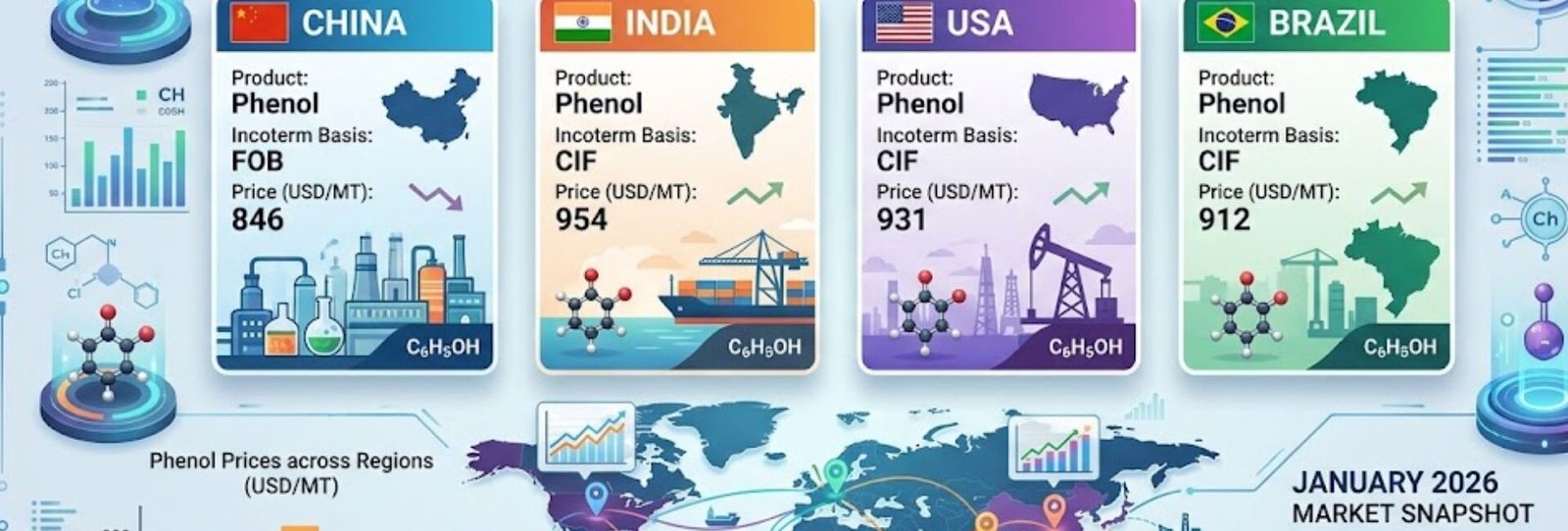
The Phenol Price Trend in early 2026 indicates a strong upward momentum, driven by tightening supply conditions, rising feedstock costs, and recovering downstream demand from industries such as automotive, construction, and electronics. Global phenol prices surged significantly from January to March 2026, particularly in Asia, where FOB China prices rose from USD 846/MT in January to USD 1,263.80/MT in March. This sharp increase reflects supply chain disruptions, improved industrial activity, and fluctuations in benzene feedstock prices, which remain a key determinant of phenol production costs.
Market Snapshot
Market Snapshot
- Market Direction: Rising
- Primary Demand Sector: Automotive, Construction, Electronics (Bisphenol-A & Resins)
- Key Feedstock: Benzene
- Major Supply Region: China, USA, Middle East
- Short-Term Outlook: Bullish
Key Drivers Affecting Phenol Prices
The global Phenol supply demand analysis highlights several critical factors influencing pricing trends:
- Feedstock Price Volatility:
Benzene price fluctuations significantly impact production costs, pushing phenol prices upward. - Strong Downstream Demand:
Increased demand from Bisphenol-A (BPA), phenolic resins, and caprolactam industries supports price growth. - Supply Constraints:
Limited operating rates and scheduled maintenance shutdowns reduced global output. - Global Production Capacity:
While capacity expansions exist, short-term supply remained tight due to operational inefficiencies. - Trade Flow Disruptions:
Export-import imbalances, especially in Asia and Europe, contributed to regional price differences.
Why Prices Increased or Decreased Recently
The recent Phenol price index shows a sharp increase, especially between February and March 2026.
- Prices in China rose from USD 936.00/MT (Feb 2026) to USD 1,263.80/MT (March 2026) (FOB).
- India CIF prices jumped significantly from USD 954/MT (Jan) to USD 2,025.15/MT (Feb 2026).
Reasons for the price increase:
- Plant Shutdowns: Temporary shutdowns in key Asian production facilities tightened supply.
- Rising Feedstock Costs: Benzene prices surged due to upstream crude oil fluctuations.
- Inventory Replenishment: Buyers restocked inventories after earlier cautious purchasing.
- Export Demand Surge: Strong demand from India and Southeast Asia boosted Chinese exports.
- Logistics Constraints: Freight cost volatility and shipping delays impacted supply chains.
Real Global Events Affecting the Market
Several macroeconomic and geopolitical developments influenced the global Phenol market trend:
- Crude Oil Price Volatility: Fluctuations in oil prices increased benzene production costs.
- Geopolitical Tensions: Ongoing global conflicts disrupted trade flows and supply chains.
- Environmental Regulations: Stricter emissions norms in China limited production rates.
- Industrial Recovery: Post-pandemic industrial recovery in Asia increased chemical consumption.
- Petrochemical Expansions: New capacity additions in the Middle East influenced long-term supply expectations.
Regional Market Analysis
North America
- Stable supply with moderate demand recovery
- Prices increased slightly from USD 931/MT (Jan) to USD 998/MT (Feb 2026) in the USA
- Balanced market conditions with controlled inventory levels
Asia Pacific
- Strongest growth region
- China experienced sharp price increases due to tight supply and export demand
- India saw significant CIF price surge due to heavy import reliance
Europe
- Moderate demand recovery
- Prices influenced by energy costs and environmental policies
- Supply remained constrained due to high operating costs
Middle East & Africa
- Emerging supply hub
- Increasing investments in petrochemical production
- Competitive export pricing impacting global trade flows
Request a Free Sample Report Now: https://www.procurementresource.com/resource-center/phenol-price-trends/pricerequest
Industry Expert Insight
Industry analysts indicate that the current Phenol market outlook is being shaped by short-term supply tightness combined with steady downstream demand, while long-term stability will depend on capacity expansions and feedstock price normalization.
Market Outlook (Short-Term + Medium-Term)
Short-Term Outlook
- Prices expected to remain bullish
- Continued supply constraints and firm demand will support elevated price levels
Medium-Term Outlook
- New production capacities may ease supply pressure
- Stabilization in crude oil and benzene prices could moderate phenol prices
- Demand from construction and automotive sectors will remain a key growth driver
The Phenol price forecast suggests gradual stabilization after the current surge, but volatility will persist due to global economic uncertainties.
Voice Search Optimization Section
What drives Phenol prices globally?
Phenol prices are driven by benzene feedstock costs, supply-demand balance, and industrial demand from BPA and resins.
Why did Phenol prices change recently?
Prices increased due to plant shutdowns, higher feedstock costs, and strong export demand.
Which industries consume Phenol the most?
Major consumers include automotive, construction, electronics, and plastics industries.
FAQ Section
What affects Phenol prices?
Phenol prices are influenced by feedstock benzene costs, supply-demand balance, and global industrial activity.
Why did Phenol prices rise recently?
Prices increased due to supply shortages, rising raw material costs, and improved downstream demand.
What industries use Phenol?
Phenol is widely used in producing Bisphenol-A, phenolic resins, caprolactam, and plastics.
Which region produces the most Phenol?
Asia Pacific, particularly China, is the leading producer of phenol globally.
What is the future outlook for Phenol prices?
The Phenol market outlook suggests short-term bullishness with potential stabilization in the medium term.
Conclusion & Strategic Insight
The global Phenol Price Trend in 2026 reflects a market driven by supply constraints, feedstock volatility, and recovering industrial demand. While short-term conditions remain tight, upcoming capacity expansions and economic factors will play a crucial role in shaping future price movements.
For detailed Phenol price insights, regional analysis, and long-term forecasts, industry stakeholders often rely on specialized chemical market intelligence reports to make informed procurement and investment decisions.