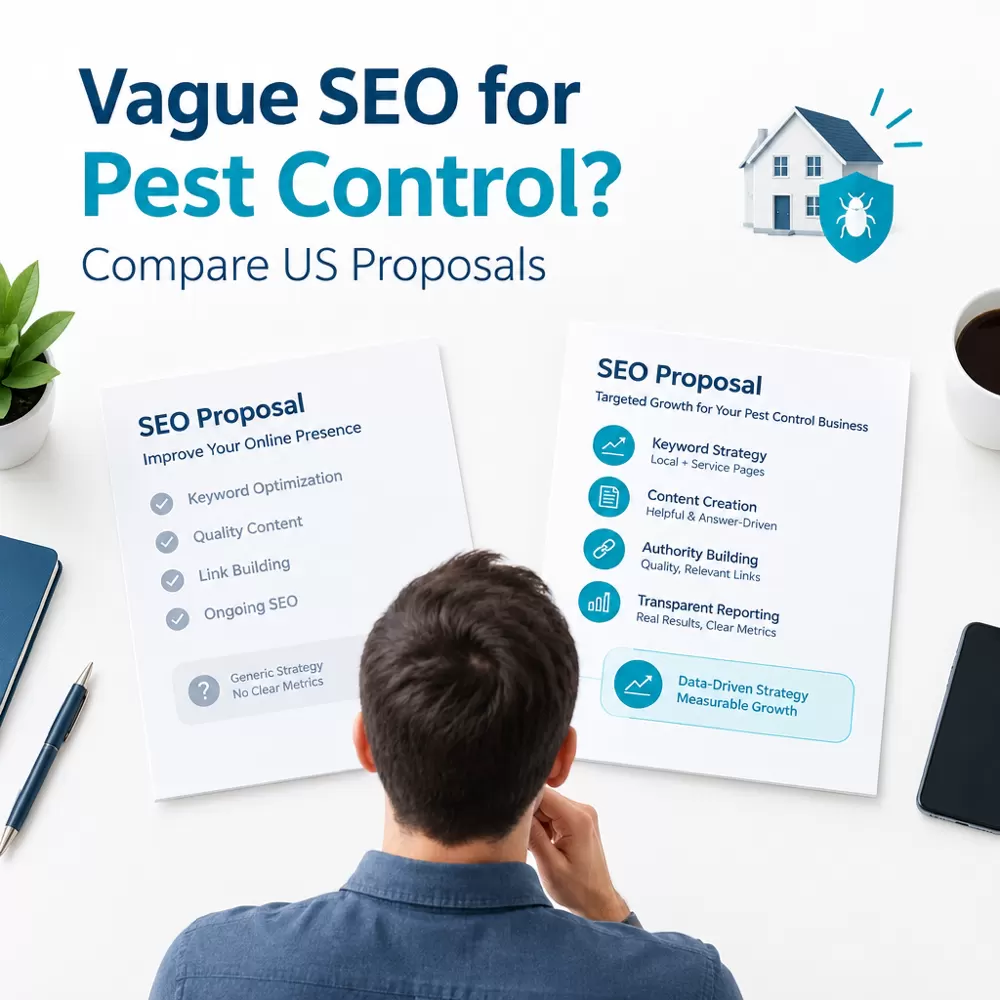
Vague SEO for Pest Control? Compare US Proposals
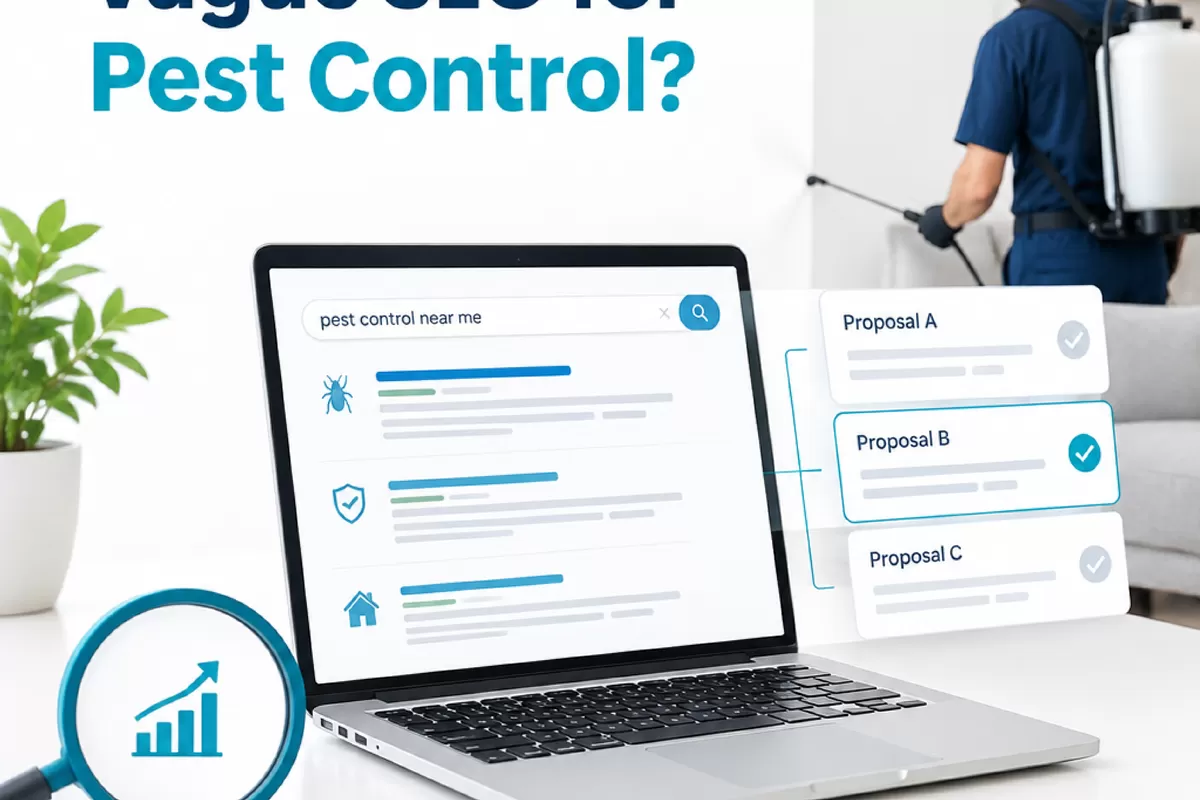 Two SEO proposals can use similar language and still describe very different work. For pest control businesses in the United States, that gap matters: a plan focused on broad traffic may miss customers searching for a local exterminator, while a polished report may not show whether calls or quote requests are improving.
Use the proposal itself as a test of how an agency thinks. A useful plan for SEO for pest control should explain its technical work, local search approach, content priorities, ethical link building, and reporting. You do not need to predict rankings. You do need to understand what the agency plans to do, why it fits your business, and how you will review progress.
What should an SEO for pest control proposal include?
Start with the work, not the promised outcome. Ask each provider to explain its proposed scope in plain language and connect each task to a problem it is meant to address. “Improve the website” is not specific enough to compare. A better proposal identifies the areas to review and how the agency will decide what needs attention.
Technical work and site structure
Technical SEO covers the site conditions that can affect crawling, indexing, and usability. Crawling is how search engines discover pages; indexing is how they store those pages for potential display in results. Ask whether the proposal includes a technical review and how findings will be prioritized. For example, can the agency explain how it would handle pages that are difficult to find, duplicate location pages, or slow and confusing mobile experiences?
Clarify who is responsible for making changes. Some agencies provide recommendations, while a business owner or web developer implements them. Neither arrangement is automatically wrong, but the proposal should state which applies, how tasks are handed off, and how completed changes are checked.
Content, links, and scope boundaries
A content plan should be tied to real customer questions and the services the company actually provides. Pest concerns vary by season and location, so ask how the agency will choose topics, organize service pages, and avoid publishing near-duplicate pages for every town. A useful plan should explain the purpose of each page, not just list a target number of articles.
Ask how the provider approaches link building, too. Ethical link building focuses on earning or obtaining relevant links through legitimate methods, rather than buying manipulative placements or promising a set number of links regardless of quality. Ask what kinds of links the agency considers appropriate, how it vets opportunities, and whether you can review the approach. Be cautious if the proposal hides its methods or treats link volume as a guaranteed shortcut.
How should a United States local SEO plan work?
For a pest control company that serves defined communities, local visibility deserves its own section in the proposal. Customers often search for a service plus a city, neighborhood, or “near me.” A complete plan should address the company’s Google Business Profile (GBP), its service-area information, and the website pages that explain where the business works. These efforts can support visibility in Google’s local results, including the map pack, but no provider can responsibly promise a specific position.
Look for a clear approach to business information consistency. NAP means name, address, and phone number. Those details should be accurate wherever the business appears, with care taken when a company operates as a service-area business and does not serve customers at its registered address. Ask how the agency will identify inconsistent listings and what it will do about them.
Local landing pages can help explain service coverage, but only when they contain useful information. A page for a particular city or neighborhood should reflect what the company truly serves and answer local customer questions. Simply swapping place names across many copies of the same page can create thin content and a poor visitor experience. Ask the agency how it will decide which locations merit distinct pages and what information will make each page genuinely useful.
Reviews also shape how people evaluate a local provider. A proposal may include guidance for requesting and responding to reviews, but the business should not pressure customers or try to control what they say. Ask how review work fits into the broader local plan, and how the agency will distinguish between visibility indicators and actual inquiries. Local SEO can help customers discover a business, but service capacity, response time, and the quality of the customer experience still affect whether that visibility turns into booked work.
Compare scope and reporting before you choose
Put proposals side by side and compare what each provider will do, what it needs from you, and how results will be reviewed. A provider’s terminology may differ from another’s, so ask for definitions rather than assuming two similar-sounding services are equivalent. For example, “local optimization” could mean profile updates, location-page recommendations, citation work, or some combination. The proposal should make that clear.
SEO Deep Insights describes its pest control service around SEO, Answer Engine Optimization (AEO), and Generative Engine Optimization (GEO), alongside technical fixes, local visibility, content, ethical link building, and reporting tied to leads and revenue. That gives a concrete example of the categories to ask about when SEO Deep Insights is among the options you are evaluating. Compare the stated scope with your own priorities, and ask how any proposed work will be tracked. AEO and GEO refer to efforts to improve how information is surfaced in answer-focused and generative search experiences; they should not replace a clear explanation of core SEO tasks.
Reporting should connect activity to useful business signals. Ask whether you will see organic search traffic, visibility for relevant local queries, and lead actions such as calls or quote requests where tracking is available. Confirm how calls and form submissions will be attributed, what access or setup is required, and how often findings will be discussed. Rankings can help diagnose visibility, but they are not the same as qualified leads or revenue.
Before signing, ask each provider these questions:
- Which technical issues will you investigate first, and who implements the fixes?
- How will you handle our GBP, service areas, citations, and location pages?
- What content do you recommend, and how will it reflect our actual services?
- How do you vet link opportunities and report the work?
- Which lead measures will we review, and what tracking setup is needed?
Pay attention to the answers as much as the proposal. A provider should be able to explain trade-offs, identify what depends on your team, and state what cannot be known before an audit. If a proposal guarantees rankings or lead volume without discussing your website, service coverage, competition, and tracking, ask for a more grounded explanation.
The best fit is not automatically the longest proposal or the one with the most deliverables. Choose the plan whose scope you can understand, whose methods you are comfortable with, and whose reporting lets you evaluate progress against business goals. If key details remain unclear, request a revised scope before you commit.